
 With increasing incidence of osteoarthritis in younger population, alternatives to knee replacement are sought to allow high function and activity levels in these patients. Joint salvage surgeries, such as high tibial osteotomy (HTO), are only effective in early arthritis when some ‘joint space’ or normal cartilage is remaining in the affected knee compartment. For more advanced or “bone-on-bone” arthritis, partial knee replacement is the recommended treatment.
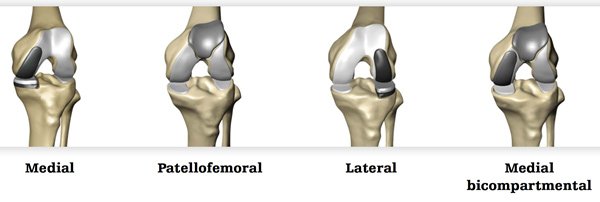
In partial knee replacement, only the affected part of the knee (medial, lateral or patellofemoral) is replaced with small prostheses, without sacrificing any ligaments of the knee. Unicompartmental knee replacement (UKR) involves resurfacing of the medial (inner) or lateral (outer) side of the knee. UKR being a smaller surgery than TKR involves a shorter incision, shorter surgical time, lesser morbidity and earlier functional recovery.
However, UKR is only possible when the wear-and-tear is limited only to one knee compartment with the knee ligaments being intact. Patellofemoral knee replacement (PFKR) is another type of partial knee replacement to treat arthritis only affecting the knee cap.
With increasing incidence of osteoarthritis in younger population, alternatives to knee replacement are sought to allow high function and activity levels in these patients. Joint salvage surgeries, such as high tibial osteotomy (HTO), are only effective in early arthritis when some ‘joint space’ or normal cartilage is remaining in the affected knee compartment. For more advanced or “bone-on-bone” arthritis, partial knee replacement is the recommended treatment.
In partial knee replacement, only the affected part of the knee (medial, lateral or patellofemoral) is replaced with small prostheses, without sacrificing any ligaments of the knee. Unicompartmental knee replacement (UKR) involves resurfacing of the medial (inner) or lateral (outer) side of the knee. UKR being a smaller surgery than TKR involves a shorter incision, shorter surgical time, lesser morbidity and earlier functional recovery.
However, UKR is only possible when the wear-and-tear is limited only to one knee compartment with the knee ligaments being intact. Patellofemoral knee replacement (PFKR) is another type of partial knee replacement to treat arthritis only affecting the knee cap.
Implants —–
- Patellofemoral joint replacement
- Unicompartmental knee replacement (Medial)